

Expandable container houses can look straightforward in a product image, but a project quotation depends on more than a model name. Buyers need to describe the intended use, number of units, required layout, destination, site conditions and responsibility boundaries in a way that suppliers can review. A clear request for quotation (RFQ) helps expose missing information before a price is compared.
SunlitTec lists container houses and board houses among its integrated-housing product families. Product names alone do not establish a unit's dimensions, expansion method, structural capacity, utility package or delivery scope. Treat each of those as a point to verify against the current model drawing and written quotation. The checklist below is designed for project buyers preparing an initial supplier discussion, not as a substitute for engineering or local code review.
Start with the project use and operating model
Describe what the units must do before specifying their appearance. A staff room, temporary project office, guest room and remote accommodation unit may share a broad product category, yet differ in occupancy, privacy, storage, accessibility, utilities and operating schedule. State whether the unit will be used seasonally or year-round, whether occupants stay overnight, and what activities take place inside.
Then describe how the units fit into the wider project. Identify whether they form one standalone building, repeated rooms, a phased accommodation area or one element beside existing facilities. Note the likely number of users at peak periods and whether shared functions such as reception, dining, sanitation or laundry are outside the unit package. This prevents a supplier from assuming that a product image represents a complete project solution.
If the project is still at concept stage, separate confirmed requirements from open decisions. For example, “12 guest units in phase one” may be fixed while the final room plan is pending. Labeling assumptions makes the first quotation more useful and reduces the risk of treating a preliminary budget as a final offer.
Define quantity, phasing and the repeatable unit
An RFQ should distinguish the number of units in the full plan from the quantity requested for the first order. Include expected later phases only as planning context, and do not imply that future prices or availability are guaranteed. Suppliers can then identify whether the same model is intended throughout or whether different layouts are needed for different functions.
Provide a simple schedule with one line per unit type. Useful fields include a buyer reference, intended use, quantity, target room arrangement, accessible or other special requirements, and whether the configuration is standard or needs review. If each unit differs, attach a marked-up plan or schedule rather than combining several variants in one sentence.
Ask the supplier to state what is included in the quoted unit and what is excluded. Clarify whether fixtures, appliances, furniture, stairs, decks, foundations, site work, connections and commissioning are included, optional or outside scope. These items can materially affect comparisons even when the product names match.
Request the current drawing and specification basis
Use a specific model name only as a starting point. Ask for the current revision of the drawing and specification that will govern the quotation. Check overall length, width and height; internal usable dimensions; room arrangement; door and window locations; and any expanded or deployed dimensions that affect access or placement. Request the definitions behind any stated floor-area figure.
The supplier should identify which information is published, which items are configurable and which require confirmation. A rendering is useful for appearance, but it should not be treated as a construction drawing. If the project depends on a particular number of rooms, occupant capacity or furniture arrangement, ask the supplier to confirm it on the model-specific plan.
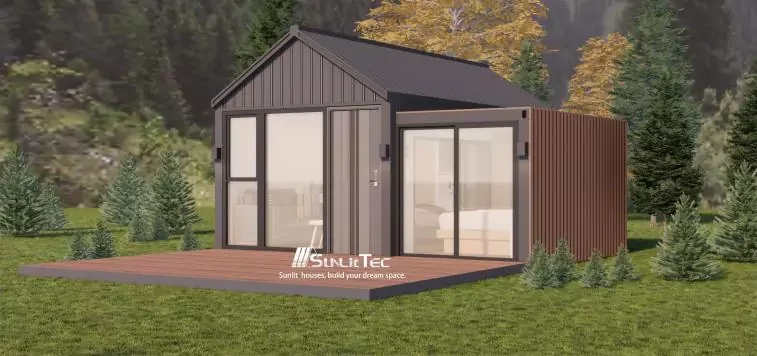
Place the visual reference beside the questions it raises. The image can help a project team discuss entry orientation, privacy, outdoor circulation or how a repeated row might feel. It cannot establish load capacity, weather performance, fire rating, insulation value or compliance. Those details need documentary evidence that applies to the selected configuration and destination.
Record site, access and utility assumptions
Site readiness is a project input, not a supplier assumption. Share the destination country and site location when known, together with a site plan, access route, ground information and expected placement area. Ask what information the supplier needs to review foundations, support points, lifting, transport clearances and utility entry locations. Any foundation design should be based on the selected unit and local site conditions by qualified professionals.
For delivery planning, distinguish transport dimensions from expanded dimensions. Ask for the packing configuration, lifting points, handling assumptions and route restrictions. An exterior image cannot establish crane access, permits or unloading requirements.
List the required utility interfaces: electrical supply, water, wastewater, communications or other project-specific services. Give the destination team's available information, such as voltage and frequency, connection location, water source and discharge approach. Ask the supplier to mark the unit-side connection points and state what equipment or connections are included. Final design and approvals remain dependent on the destination and project conditions.
Ask focused questions about materials and performance
Avoid a broad request such as “confirm quality.” Tie each performance question to the operating conditions that matter. State the expected temperature range, exposure, occupancy pattern, cleaning regime and any relevant environmental conditions. Ask what evidence is available for the actual proposed assembly and which assumptions it covers.
For insulation, acoustic comfort, corrosion protection, fire performance, wind or snow loads, request the specific value, test document or drawing reference that applies to the selected model. If the supplier cannot confirm a requirement yet, record it as open and ask what additional information is needed. Do not substitute a generic company certificate or a different model's document for product-level evidence.
For certifications, ask for the holder, scope, issuing body, validity and products covered. A company management-system statement does not prove that a building configuration complies with local rules; have the local project team identify required approvals and documents.
Make commercial and responsibility boundaries comparable
Request a quotation that states its currency, validity period, configuration, included items, optional items and exclusions. Ask the supplier to identify the delivery term being offered, the named place, and which party is responsible for transport, insurance, import clearance, duties, unloading and onward movement. These are commercial terms to agree in writing; do not infer them from the supplier's location.
Also ask how changes are handled after approval. Identify the drawing revision that will be used for production, the process for approving substitutions and the documents expected before manufacture or dispatch. If a delivery date is important, ask the supplier to state the assumptions and the event from which the schedule is measured. Do not treat a preliminary estimate as a commitment.
Compare offers on the same scope. A lower unit price may omit furniture, utility equipment, site work or delivery-related services that another offer includes. Create a line-by-line comparison, mark “included,” “optional,” “excluded” or “to be confirmed,” and resolve the largest gaps before making a selection.
Build an RFQ package suppliers can answer
A concise first package can include:
- Project use, destination and operating schedule.
- Unit types, first-phase quantity and possible future phases.
- Required layout, occupancy and any special access needs.
- Current site plan, placement area, access route and available ground information.
- Utility requirements and known local connection details.
- Required documents, standards or approval questions supplied by the local project team.
- Target quotation date, decision milestones and preferred commercial assumptions.
- A list of confirmed requirements, assumptions and unanswered questions.
For model-specific details, review the current container house product range and explain which product image or configuration prompted the inquiry. If the scope is not settled, send the destination, use case, target quantity and key open questions through the project inquiry page. Buyers comparing other project types can also review public and commercial project uses and the company's customization information.
Conclusion
An expandable container house RFQ is most useful when it gives suppliers a shared, testable scope. State the project use, quantities, layout, site and utility assumptions, then ask for model-specific drawings, evidence and written responsibility boundaries. Mark unknowns instead of filling them with guesses. This makes quotations easier to compare and gives the project team a clear list of decisions to resolve before purchase.
Frequently asked questions
What should I include in an expandable container house RFQ?
Include intended use, destination, quantity, room plan, site information, utility requirements, requested documents and commercial assumptions. Separate fixed requirements from items still under review.
Can a supplier quote from a product photo?
A photo can identify the style or model family, but a reliable project quotation also needs the current drawing, configuration, quantity, destination and scope boundaries. Ask the supplier to confirm which revision the offer uses.
Should the buyer choose a foundation before requesting a quote?
The buyer should share available site and ground information, but foundation design depends on the selected unit and local conditions. Coordinate the current unit interface information with a qualified local engineer.
How can I compare two supplier quotations fairly?
Align the model, drawing revision, quantity, included equipment, exclusions, delivery assumptions and documentation. Record items that remain optional or unconfirmed instead of comparing headline prices alone.
Request an RFQ review
Send SunlitTec the intended use, destination, unit quantity, preferred layout, available site information and any required documents. If some details are undecided, identify them as open questions. The team can then review the product fit and confirm which model-specific information is needed for a written quotation.